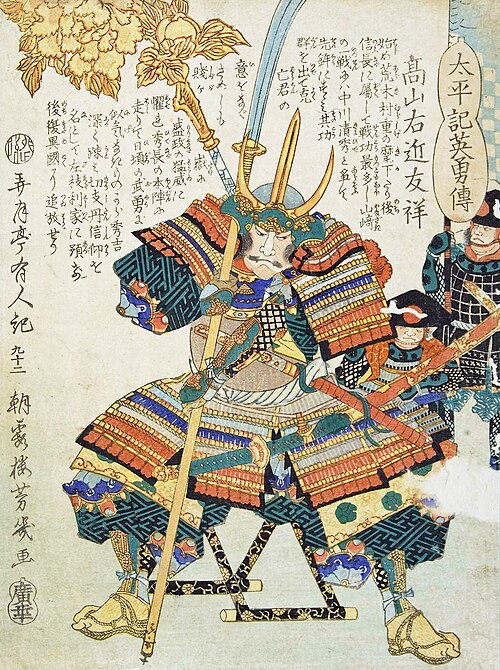
The Christian Samurai: Takayama Ukon and Japan’s Hidden Christians
Could a samurai be Christian?
At first, those two identities may sound as though they belong in completely different history books.
Christianity originated thousands of miles from Japan. The samurai belonged to a warrior tradition deeply embedded in Japanese society. Yet in the upheaval of sixteenth-century Japan, those worlds met—and some members of Japan’s warrior elite converted to the new religion. One of them was Takayama Ukon.
His story would eventually involve war, political power, religious persecution, the loss of his lands and exile from his country. But it is also part of a much larger story about what happens when a new belief enters an established culture—and what people are willing to risk to preserve it.
Christianity Comes to Japan
European contact with Japan began in the 1540s. Portuguese traders arrived in 1543, bringing not only new trade goods but technologies and ideas that quickly attracted Japanese attention.
Six years later, in 1549, the Jesuit missionary Francis Xavier arrived in Kagoshima and began preaching Christianity.
Christianity did not remain solely the religion of foreign visitors. Japanese converts came from different levels of society, and some powerful daimyō—feudal lords—also embraced or supported the new religion. Political and economic interests, including access to Portuguese trade, could overlap with religious ones, making the spread of Christianity considerably more complicated than a simple story of missionary and convert.
It was into this changing Japan that Takayama Ukon was born around 1552.
Meet Takayama Ukon
Takayama came from a daimyō family and was therefore part of Japan’s warrior elite. His family encountered Christian missionaries, and Takayama was baptized as a boy, taking the Christian name Justo. He later became a daimyō himself.
That combination is worth lingering over.
Takayama did not stop being Japanese when he became Christian. Nor did his conversion erase his place within the warrior society in which he had been raised.
He was a warrior, landholder and political figure.
And he was a Christian.
For a time, those identities could coexist.
Then Japan’s political landscape changed.
When Faith and Loyalty Collide
In 1587, Toyotomi Hideyoshi moved against Christian missionaries, ordering their expulsion from Japan.
For Takayama, the conflict was no longer theoretical.
His status and property depended upon the political system in which he lived. His Christian faith had become an important part of his identity. When pressure came to abandon that faith, Takayama refused.
He lost his position and lands rather than renounce Christianity.
It is tempting to reduce this moment to a simple tale of religious persecution, but the political reality surrounding Christianity in Japan was much more complicated. Missionaries existed alongside European traders and expanding foreign influence at the same time Japanese leaders were attempting to consolidate political control after generations of conflict.
Religion, commerce, foreign relations and domestic power could not always be neatly separated.
Takayama nevertheless faced the consequences as an individual.
The question was no longer whether he could simultaneously be a samurai and a Christian.
It was what he would do when those loyalties could no longer comfortably coexist.
From Daimyō to Exile
Takayama survived the loss of his lands and spent years under the protection of other powerful Japanese lords.
But persecution of Christianity intensified.
In 1614, the Tokugawa government imposed a broader prohibition on Christianity, and Takayama was expelled from Japan along with other Japanese Christians. He sailed to the Philippines and arrived in Manila in December 1614.
The former daimyō was now an exile.
He died in Manila on February 3, 1615.
Takayama's individual story ended there.
The story of Christianity in Japan did not.
The Christians Who Stayed
When missionaries were expelled and public practice of Christianity was prohibited, some Japanese Christians abandoned the religion.
Others took it underground.
Communities of believers—particularly around Nagasaki and the islands and coastal regions of northwestern Kyushu—continued transmitting elements of their faith in secret.
They did so for more than two centuries.
Without the institutional structures that had originally brought Christianity to Japan, these communities adapted.
Some established villages in remote locations. Their religious practices developed in distinctive ways as generations attempted to preserve beliefs without public churches or ordinary access to clergy. UNESCO describes the resulting tradition as both vernacular and recognizably rooted in Christianity.
The prohibition was eventually lifted in 1873.
Descendants of Japan's hidden Christian communities were still there.
What Survived
Today, the Hidden Christian Sites in the Nagasaki Region are recognized as a UNESCO World Heritage Site.
The designation encompasses twelve components: ten villages, the remains of Hara Castle and a cathedral. Together, they preserve evidence of the encounter with Christianity, its prohibition, more than two centuries of secret religious transmission, and the later revitalization of Christian communities.
That makes Takayama Ukon much more interesting to me than the novelty of calling someone a “Christian samurai.”
His life sits at the intersection of several enormous historical changes.
Japan was undergoing political unification. European traders and missionaries were arriving with unfamiliar technologies, beliefs and economic opportunities. Japanese leaders had to decide what kinds of foreign influence they would tolerate. Individual Japanese people, meanwhile, were making their own decisions about which new ideas they would accept—and what they would do when those choices came into conflict with the demands of their society.
Takayama made one choice.
The hidden Christians who came after him made countless others.
Some beliefs were abandoned.
Some were adapted.
Some were hidden.
And some survived for generations.
Perhaps that's the more interesting question history leaves us with.
Not simply “Could a samurai be Christian?”
But:
What happens when part of your identity becomes something the world around you will no longer allow you to be?